Wednesday, July 20, 2011

Day 11 Yangtze River -- Shibaozhai


After having cruised down the Yangtze River all night, we continued cruising until mid-afternoon.  The Yangtze River flows through mountainous country, so the sights along the river were mountain sides and other boats.  The air has been hazy to foggy most of the time we have been in China, but it was thicker at the river.  Mountains were shrouded in haze so that sometimes only an outline was visible.  The river is the main highway of the area, so almost all goods and people are transported by boat.  There were boats of all kinds:  barges, ferries, coal barges, dredges, fishing boats, water taxis, and cruise ships.  Some of the fishing boats were single person skiffs; others were larger flat-bottomed boats with a cabin.  All appeared to have a motor.

Homes were scattered singly and in villages all along the river, mostly up on the sides of the mountains.  They were all very similar concrete multistory structures.  They looked like they would accommodate several families.  There were several medium-sized cities along the river.  These had high-rise apartment buildings.  We were told that many of the high-rises did not have elevators.  Almost everything along the river is relatively new.  When the river was dammed, 1.3 million people were displaced from the original banks of the river to higher ground or somewhere else, so the current cities, towns, villages, and rural dwellings had been built above the new flood zone.


In the afternoon, we stopped at Shibaozhai to tour a Pagoda.  This Pagoda had its initial construction over 1,000 years ago, was mainly built in 1650,  and was added to as recently as 1954.  It had been built onto the side of a mountain and contains statues and carvings at many levels that illustrate Buddhism.  It is now  twelve storeys tall.  We climbed all 99 wooden stairs to the top.  The steps were unevenly spaced (some were about a foot up), and some flights were almost straight up.  I think we were the oldest ones in our group to climb the tower; it was hot, but we made it.

The staff put on a Chinese Traditional Dress Style Show in the evening as we "sailed" on down the river through the night.

Pictures:  Viking Emerald, Scenes along the Yangtze River, Shibaozhao Pagoda


Yangtze River water


Tuesday, July 19, 2011

Day 10 Chongqing and Yangtze River

On this day, we had nothing scheduled for the morning, so we had breakfast at the hotel and walked around the hotel area.  Just two blocks away, there was a large modern shopping area.  Many of the stores were upscale with expensive clothing and other items (such as BMW's).  The signs for KFC, McDonalds, and Starbucks stood out among the signs for the other stores in Chinese characters.  The streets and walkways extended in several directions from a central plaza.
 
Chongqing is built on hills and has two major rivers flowing through it, so it is not laid out on a grid with streets intersecting at right angles as we had seen in the other cities we had visited.  Instead, the streets run at odd angles to each other, and the total effect is a random pattern (that probably followed trails developed by animals or early inhabitants who used the easiest route and not a predetermined grid).  Getting around in Chingqing is only possible if you can climb stairs up the many hills.  Another effect of the steep slopes in the city is that there are no bicycles or other pedal-driven vehicles; it would be almost impossible to ride a bicycle here (all of theother cities we have visited had bicycles and pedal-driven trucks, carts, and rickshaws in large numbers).  Chongqing is a large city of 32 million people.  It appears that most of that population is housed in high-rise apartments and condominiums. I haven't seen such a large collection of high-rise office and residential buildings anywhere else (perhaps Shanghai).  It is an industrial city with a number of automobile assembly plants.

At noon, we left the hotel by bus and went to a restaurant for lunch -- another Chinese spread.  Then we went to the General Stillwell Museum and the Flying Tigers Museum.  These displayed the role of the United States military in helping China fight against the Japanese during World War II.  Our next stop was the Chongqing market.  As we walked through the market we saw fresh meat and vegetables for sale.  The meat was cut and hung for customers to select the cut they wanted.  There were oddities (to us) such as live eels and frogs and pig's feet.  About every type of edible vegetable was available.  The most eyecatching were the bright red peppers, especially when displayed next to green beans.  Owners of the booths were often busy working on their wares (such as a very old woman who was shelling peas).  We were told that the Chinese shop for food daily and demand fresh food; that anything left at the end of the day would be discarded because it wouldn't be fresh the next day.
 
Now it was time for us to board the ship for our trip down the Yangtze River.  The boat is like a moving hotel.  Our room is small but has a bathroom with a shower and is comfortable.  We will stay on the boat for 5 days and nights as we explore along the river.   We left Chongqing at 10:00 p.m.  Chongqing buildings were bright with colored lights that moved and changed colors.  One entire building became a giant screen displaying videos (advertising, I think).  Moving by all of these lighted buildings created the feeling that the entire city was out to see us off on our adventure.

Pictures:  Chongqing scenes, Viking Emerald River Boat


Sunday, July 17, 2011

Day 9 Dazu Stone Carvings


This was primarily a travel day.  The one site scheduled was the Stone Carvings near Dazu.  To get there, we traveled by bus about 5 hours over winding mountain roads.  This was our first time to see the Chinese countryside (other than the short trips we had taken to sites near the cities where we stayed).  The air was hazy (almost foggy), which obscured distance view, but as the day went on, the haze almost disappeared, and we had sunshine in the afternoon.  It was hot and humid.  On the drive, we saw several smaller towns and farming areas.  The small towns often had high rise apartments just as we had seen in the cities, but the rural areas had individual houses (made of concrete as usual) dotted around the countryside fairly close together.  The fields were small, so it was obvious that most of the farmwork was done by hand (no farm machines could operate in those small fields, and I didn't see any tractors).  Rice was the most prevalent crop.  At this season, the rice looked about 12 - 18 inches tall.  There were channels to bring in water to flood the rice fields.  We also saw small fields of corn, fruits, and vegetables.  Pumpkins growing on trellises stood out with bright yellow flowers.  In many places, the hills and mountains were terraced to provide more farmland, but it appeared to me that the terraces were not being used now.  There were some significant mountains along the way.  The road took us through several long tunnels through the mountains. The countryside (other than having rice fields and terraced hills) looked like the countryside in the U.S. southeastern states with tree-covered rolling hills and mountains.
At the Dazu Stone Carvings, we found a beautiful site where images were carved into a sandstone cliff.  These were large carvings -- some were at least 30 feet tall.  The carvings stretched along the cliff for about 1000 feet and into a cave.  Many of them were painted with gold and blue. They depicted different aspects of enlightenment as professed by Buddhism, but they also expressed tenets of Tao and Confucian beliefs.  They had been carved druing the 7th century, and no obvious damage or erosion was noticeable.  To see these, we had to descend by trails and steps to the level of the carvings on the cliff face and eventually climb back out on one of the longest set of stair steps that I remember seeing or climbing.  This was a challenge on such a hot and humid day.  Again, I was struck that a culture would undertake such a project that involved a long-term commitment of time and resources.
From Dazu, we drove on another 2 hours to Chongqing, one of the largest cities in the world (about 30 million).  We stayed in a hotel in the downtown area and had a dinner that, for the first time since the tour began, included western foods. 

Pictures:  Rice Field (taken from moving bus), Judy with students who asked to interview her, Stone Carvings (4).


Saturday, July 16, 2011

Day 8 Pandas


At 8:00 a.m., we set out for the Panda Research Center, which is near Chengdu.  Again, traffic was heavy, and we arrived at about 9:00 a.m.   The center was a beautiful natural area in which Pandas can move freely.  There are housing, play areas, and feeding areas that are much like a zoo setting but they can roam throughout a large area and find Bamboo to eat in many places.   We began walking up the trail through the zoo, and before long, we encountered a group of five Giant Pandas.  Three of them were sitting on the ground busily eating Bamboo, biting off large stems and chewing them quickly.  There was a large crowd of people at the low fence watching the Giant Pandas, who seemed oblivious to the crowd.  There were two other Giant Pandas resting in a play area.  One was lounging in a tree; the other was spread out on a platform built of large bamboo stems.  Bamboo is their only food, and they use it very inefficiently, so they spend most of their time eating and resting (to save energy we were told).  Later we saw several more Giant Pandas in trees.  They were just as striking to see with their black and white fur and black eye spots as we had expected from the videos that we had seen over the years.  We had seen the pair of Giant Pandas at the National Zoo in Washington D.C. years ago, but seeing them in their natural setting was much more interesting.  At the center, researchers are trying to learn what works best to help the Giant Pandas survive and increase in numbers. 

At one point, a station was set up so that patrons could actually hold a young Giant Panda while the attendants photographed the holder and Panda.  Giant Pandas are large bears, so the ones available for holding were obviously young ones.  Several in our group got in line, paid the fee (equal to $160) and came out with their photographs and pure excitement.  We didn't join in, but our group includes a family from Calgary, Alberta with two 12-year old boys (twins).  Holding the Giant Pandas was one of the highlights of their trip. 

Later along the trail, we encountered a group of Red Pandas.  They were being fed, so we were able to watch them up close.  These animals are about the size of a medium-sized dog with long banded tails and red fur.  They looked like large raccoons, but their faces had the rounded shape of a Panda.  Again, it was exciting to see an endangered animal up close and know that they were receiving the attention needed to ensure that the species did not disappear.

The next stop on the tour was the Shangxidui Bronze Museum, where we saw artifacts from Chinese history and culture.  Most of the large collection were masks made of bronze that had been found in a tomb unearthed near the museum.  The masks had distinctive diamond shaped eyes, but they illustrated great variety in the other facial features and in their size.  The items were dated 700-600 B.C.  The museum also contained a collection of items that had been made of Jade.  There were large blocks of Jade that had not been carved to illustrate what the Jade was like as it was mined.  Many of these items were intricately carved and shaped to be useful as well as decorative items.

We ended the day with another expansive spread of Chinese food that represented the Sichuan District of China.

Pictures:  Panda Breeding Preserve, Shangxidui Bronze Museum


Day 7 Xian to Chengdu

We began as usual now with a big breakfast, which is needed because we may not get to lunch before 2:00 p.m. after we have walked miles and climbed many flights of stairs.  This tour is not for the weak.  We boarded our bus for the Provincial Museum in Xian.  This is a museum that contains relics of China's ancient history.  There we saw bronze pots, terracotta soldiers, ceramic pots and animals (probably the first use of glazing), and other objects that were thousands of years old.  The many Dynasties are still confusing, but I have learned that the Terracotta Army was constructed during the Qin Dynasty about 200 B.C. 
Then we were off to the airport to fly to Chengdu.  During this flight, we flew over Jingling Mountain, which means we have transferred from northern China to southern China.  These are almost two separate cultures.  For example, the food in northern China is based on wheat (noodles), and the food in southern China is based on rice.  The flight was about an hour and a half long and was again in a large airplane (A320) that was nearly full.  Both airports (Xian and Chengdu) were crowded and bustling.  Chengdu is building an entirely new terminal, so we had to disembark somewhere out on the runway and take a bus through the construction to the old terminal.  We stopped on the way into the city for a lunch consisting of a variety of Chinese food.
Next we went to a park that was a quiet oasis in a noisy city (Chengdu is a city of 12.5 million).  There were paths through a woods (much of it was bamboo) that led to a tea house.  Tea houses are common and are the places where local people gather to visit, drink tea, and play mahjong.   Mahjong is serious business (with automatic tile-shuffling tables and gambling).  Several foursomes were playing when we arrived.  We were seated at a long table and served jasmine tea.  While we were there men came around offering backrubs (for a price).  Judy had a good backrub.  The park was a very pleasant respite after our busy schedule and having made our way through two airports.
After the park visit, we headed to a special restaurant for a big dinner.  It takes a long time to get around in Chengdu (as it had in Beijing and Xian) because we are traveling about a city with a large population and more cars, trucks, and buses than you can imagine.  The drivers seem to consider driving as a contact sport with each vying for advantage.  Every intersection is a war among drivers, motor bikers, bicyclers, and pedestrians.  But we have yet to see an accident.  Dinner was another abundance of Chinese food; we sampled most of it, but I can't remember what we ate.  Again we saw a city under construction.  New high rise office buildings and apartments were being built everywhere and were brightly lighted at night.
Finally, we arrived at the hotel.  Our luggage was waiting in our room.  Now we had to do some laundry.  Every day has been hot and humid, which means that clothes must be washed.  And tomorrow is another day.

Pictures:  Chengdu Tea Garden, Xian Provincial Museum


Day 6 Xian -- Terracotta Army

We began this day as usual with a big breakfast at the hotel, then we proceeded by bus to the Terracotta Army area.  The Terracotta Soldiers were built ( ca. 250 b.c.) to be buried with the emperor of the Qin Dynasty.  A farmer discovered them in 1974 and they have been and are still being unearthed carefully to preserve the history (about 2,000 to date and about 6,000 more expected to be found).  The army is maintained in the excavation areas that have been enclosed in huge buildings.  Again, we were among the thousands of visitors. 
The soldiers show intricate detail with each soldier and horse being unique.  It was an incredible sight.  The sheer numbers as well as the detail of the soldiers is unbelievable.  We spent several hours at the exhibit looking a different pits and museum.  We marveled at a culture that could focus the resources and time on the creation and implementation of such a project (as we had with the Great Wall).   At the time of our visit, workers were out in the pits and at tables working on the excavation, restoration, and cataloging of the finds.
Our next stop was a late lunch with a variety of Chinese food served family style.  Then we went to the "Wild Goose Pagoda."  The Pagoda is a 7-story tower built about 1,000 years ago.  It replaced a similar building that burned.  The Pagoda is a Buddhist Temple.   When we visited, there was a large crowd also visiting.  We saw the monks in study, with women on one side of the room, chanting.  We also say the monks march to a bell tower and perform a ceremony.
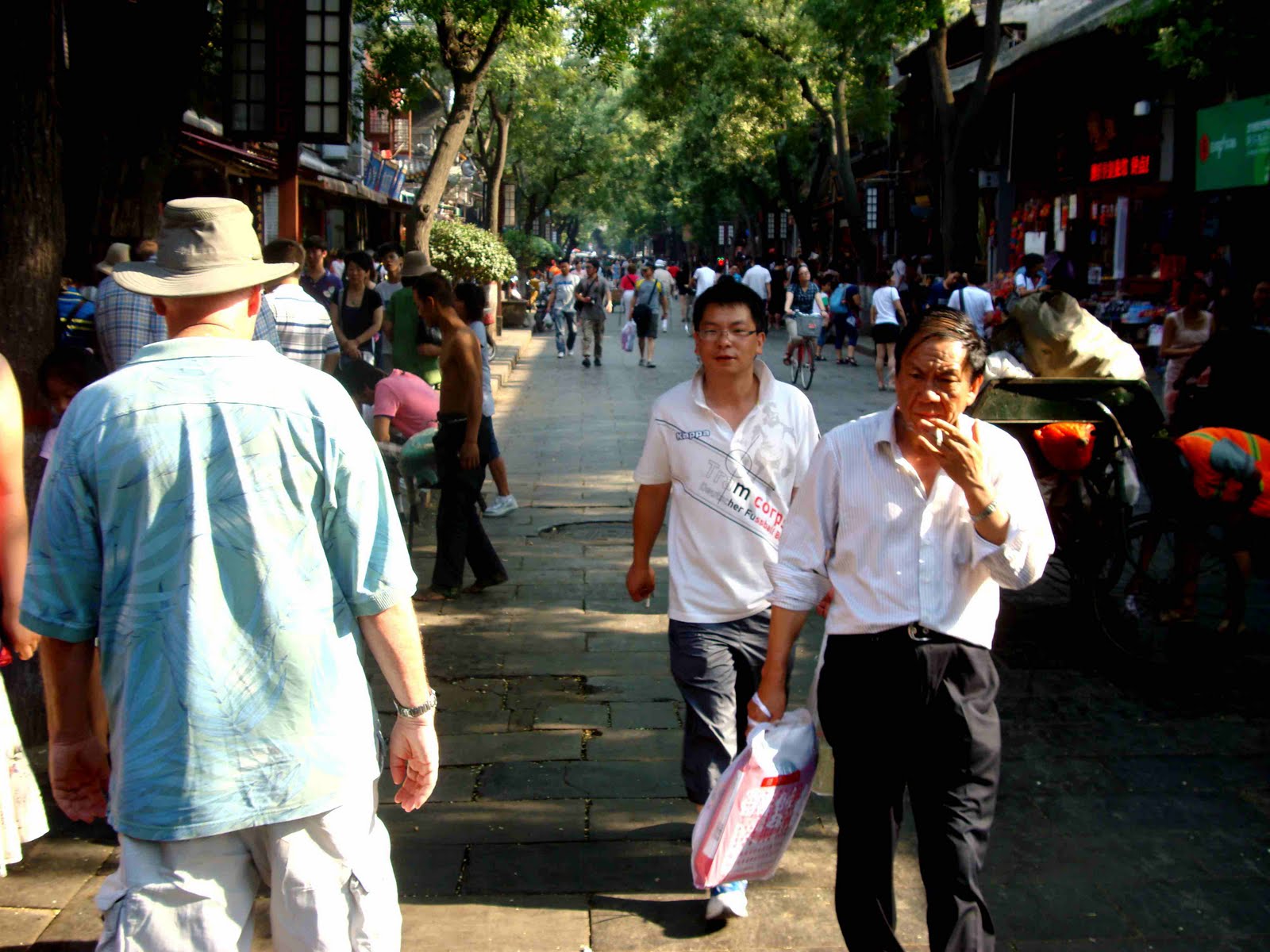
Following that, we Muslim Quarter Market, a historic shopping area in the center of Xian.  There the shops were open to the street and carried about every kind of food and item imaginable.  It was also packed with people (by now it is about 6:00 p.m.).  Although it was historically the Muslim area, and still is Muslim, there was little trace of Arabic influence.  We ate in a restaurant in the area whose specialty was dumplings.  We were served family style 20 different types of dumplings.  The guides with us seemed to really like the dumplings, but we found them very strange and not at all tasty.

As we drove around Xian getting to our appointed places, several times, we passed an public library in an elaborate modern building.  It was in an area with a performing arts center and near a University specializing in arts.  After 12 hours on the road, we arrived back at our hotel for some much needed rest.

Pictures:  Terracotta Army, Wildgoose Pagoda, Muslim Market